Showing posts with label back button focus. Show all posts

Sunday, August 23, 2015

Bracketing Those Shots

Round Bales in the Field
Lately, I have changed my photography process. It started when I discovered that Magic Lantern was available for my Canon 60D. For those wondering what that is, think of a firmware add-on which extends the capabilities of your camera. Near and dear to my heart, it is open source software that the camera reads from the memory card as it starts up, so no concerns about "bricking" my camera ! More importantly, it has added a host of options that I am really starting to enjoy using.
The default Canon firmware has a setting called "Auto Bracket", which allows the photographer to set up a three-shot bracket around the optimal exposure, and the photographer then sets the number of EV (in 1/3 stop increments) between captures. With Magic Lantern, the photographer has a lot more control - either choosing how many shots in the bracket manually, or letting the software determine what it needs in-camera.
On the back end, Lightroom CC has the ability to take the bracketed shots and merge them into one, creating an HDR-style photograph without all of the weird side-effects. There is also a nifty function called "anti-ghosting" which will attempt to eliminate any elements that occur in one of the frames but not all of them - like a truck or bird passing through the frame !

So all the way through, my choices have encouraged me to create bracketed photos, which bring out an added feeling of depth and warmth. These various functions, when properly mixed, have made complex techniques very straight-forward, allowing me to concentrate on the composition more. And that I where I know I need to focus more of my attention !

Sunday, April 6, 2014

Project365 - Two Strobe Portraits

Introduction
In my last installment, I refined my technique for creating a deep black background. In this shoot, I applied that technique, along with two flashes to create more interesting portraits.


The Setup

My thought was to set up for a black background, and then light the model from above and to her right. Then, I wanted to place another strobe below and behind her. I was hoping to create a sort of light halo effect. Unfortunately, I didn't get the halo as her hair was as dark as the background. Worse, I had remarkably dark shadows across her face.

I shot the Canon 60D handheld. In the hotshoe was one of the Cactus v5s. I was set for a black background - f/250, ISO 100 and an aperture of 16. One Canon 430EX II was mounted on a Cactus v5 atop a tripod to the kodel's right, while the other was mounted on the trigger and placed on the floor.

The Photos

I am still learning about portraiture. It's not really something I'm very good at, so I was fortunate that my daughter agreed to be my model. It is easy to have a good rapport...

In this first photo, the main light was too powerful. While I had a nice dark background, you couldn't really see any definition between the background and the kodel's hair. And the pose is funny - unnatural, even. It looks like her eyes are pointed in two different directions !


Here, the main light is better, but the secondary is still underpowered. There are very harsh shadows on the models face. Given how pale her skin is, I would've liked to have made her skin tones warmer with a bit of makeup.


This one is better. We see a nice cross-lit effect, haloing her cheek and chin. And there is even a hint of catch-lights in her eyes ! But her dark hair is lost in the black background, still.


This is a little bit tighter a shot. I like the effect of the cross-lighting, and the black background.


Lessons Learned

I still need to figure out how to create the halo effect around the model's hair. I suspect my life would be easier shooting at night, when the room is darker to begin with. I'd also like to try to use a reflector to cross-light the face, which would free up the flash for the halo effect !


Sunday, March 30, 2014

Project365 - Second Curtain Flash

Introduction
The kids are over for the weekend, but the continual snow has everybody a little down. So what better to lift everybody's mood than a little RC Car racing ? Since the cars move on a set track, it's pretty straightforward to capture some of the action. It's also a great opportunity to try a new technique called Second Curtain Flash.

The idea is that under normal conditions the flash fires as the shutter opens, freezing the action. Then, depending on the shutter speed, the shutter closes again, finishing the shot. Second Curtain Shutter delays the flash until the shutter is about to close. So in slightly longer exposure shots, the effect is to capture some blur of movement, and then freeze the action with the flash.

The Setup

My trusty Canon 60D, with the venerable 24-105mm f/4 L lens. The Canon 430EX II flash is mounted on the hotshoe, and set to ETTL and Second Curtain Flash. In order to get the blur, the shutter was set to 1/4 second, aperture at f8, and the ISO at 125. I shot handheld, as I was down on the floor, on my belly to achieve the look I wanted.

The Photos

A little racing action sees the grey car passing the yellow car. The blue streaks are actually the Bluetooth indicator lights on top of the cars.


I really like how the yellow car blurs brightly. You get such a sense of speed from this effect !


Taken a little bit wider, both cars are in the frame. Unfortunately, there's not much contrast between the grey car's "blur" and the dark background. So it's not as good as I had hoped.


Lessons Learned

This was a quick little shoot - only a dozen or so photos. I like the effect, but have come to realize that it works best when you have high contrast between the background and the subject.


Wednesday, March 26, 2014

Project365 - Let's Go For a Drive !

Introduction
I have been thinking about this shoot for a while. I wanted to play with motion, but instead of having the subject crisp & everything else blurry - ala Bokeh - I wanted to capture the feeling of being in motion. After shooting the Auto Strobism shoot, I liked the setup in the car. And this gave me the idea for the shoot !


The Setup

This was a lot more of a complex setup than I expected. The idea was to mount the camera (Canon 60D), on the Manfrotto tripod in the back seat of the truck. In order to capture the entire windshield, as well as the occupants of the front seat, I switched to the Canon17-40mm f/4 wide-angle lens, and kept it at 17mm. I was worried about the stability of it all, so I looped the neck strap of the camera over the centre headrest. Finally, in order to get some light in the cabin, we set up the Canon 430EX II flash with my inflatable diffuser.

This photo (taken with my iPhone) shows the camera on the tripod, and the flash mounted in the hotshoe. As you can see, the iPhone camera really sucks in low-light conditions ! With the camera in the back seat, the setup was laborious - pull over, hop in the backseat, make adjustments, test shoot, refocus & start all over again !


In this side shot, you can see the shutter release cable dangling down from the camera body. Unfortunately, the cable is very short, so Pat had to hold her hand back behind her (out of the shot) to take the photos. She was an absolute trooper for staying in that position through 90 minutes and 270 shots !


The Photos

Here we are in the driveway. I knew I'd need to have some light inside the cabin, but we spent a few minutes figuring out the placement. At first, I thought off-camera would look good. I really didn't like how this looked at all - very unnatural !


Here is the first good shot - the cabin of the truck & passengers are reasonably lit, and in-focus. The outside is visible and somewhat blurry. The exposures were taken at 1 second, to enhance the feeling of motion.


This is actually one of my favorites. Most of the outside is blurry - look at the streaky headlights of the oncoming traffic ! But I was keeping pace with the car on our right, so it stayed reasonably in focus. This is the style I was after !


Man down ! Apparently, the rig wasn't as stable as I had hoped. I'm fortunate nothing got damaged as the tripod toppled over...


Occasionally, if we paused for too long, the flash would go into battery-saving mode, and not fire on the first shot. So we have about a dozen shots with no interior lighting.


This photo illustrates one of our challenges - how bumpy Calgary's roads are. The streak on the left is an oncoming car. The headlights waver up & down as the truck contends with the uneven road surface. That internal shake ruined quite a few shots entirely.


This photo was taken as we drove over the flyover into the downtown core. The exterior is blurred, giving the feeling of motion, while still focused enough to see where we are.


This is one of my favorite photos captured of the night's shoot. The passing traffic really conveys the feeling of movement. The viewer really feels like they are in the truck with us, driving through the city.


Lessons Learned

This was a complex shoot. I have to give a LOT of credit to my assistant, Pat. She not only fired off the 270 frames, but also had my iPad in her lap (out of sight of the camera) to validate we were getting the shots we wanted. The rigging of the camera in the backseat was OK - we really only toppled over twice in over 90 minutes of shooting. The shutter release cable is WAY too short - I think I am going to investigate a wireless option.

Over all, I am happy with the results. We captured about a dozen really cool photographs, which beautifully convey the feeling of motion. Let me know of you agree ! =D


Saturday, March 8, 2014

Project365 - Red Sky in Morning

Introduction
While I like learning new techniques, I am also learning to apply techniques I have learned in new and different ways. This helps me grow my "creative" side. So this morning, I was driving south to meet my friend for coffees. Along the way I spied this church which was lit up & backlit by the sunrise. While I liked the colours, I knew that I would struggle with the low light. High dynamic range to the rescue !
The Setup
Nothing especially difficult here - my Canon 60D with the Canon 24-105mm f/4 L lens, all riding atop the Manfrotto tripod for stability. I set up the bracketing function, to capture +/- 1.3 stops. This will give me the dark, medium & light frames required. The scene was still, and the shutter speed was slow (about 1.5 seconds), so no need for setting up the AI-Servo to take three pictures at a time.
The Photos
The "darker" photo, at -1.3 EV

The "medium" photo, at 0EV


The "lighter" photo, at +1.3 EV


Now you'd think why bother with the under and over exposed photos. Isn't the "normal" (0EV) picture going to look the same ? In fact, it does not. I must confess I did post-process the final image slightly, but merely to crop the image. Here is the final product:

Lessons Learned
As you can see, the blues & pinks in the sky are much more vibrant. So while HDR didn't do much for capturing highlights & lowlights - it is often used in scenes where there is lots of shadow - it certainly helped capture the brilliant hues in the early morning sky. Further, the accent lighting on the building seems to "pop" more, adding a bit of drama to the photograph.
All in, I think that was an excellent way to use the technique to capture the photo I wanted. I am pleased with the end-result.

Sunday, March 2, 2014

Project365 - Almost Macro

Introduction
I must admit, I think macro photography is cool. For those unfamiliar with the term, it's the photographic method for taking pictures of very tiny objects. Imagine an 8X10 photograph of a bug's eye or a grain of rice. There are so many wondrous things around us, yet they are too small for the naked eye to see.

I had taken a few pictures (in this post) of Pat's tulips using an extension tube and my Canon 40mm f/2.8 prime lens. When I posted them, my new Facebook friend Dave asked me how I had captured them. When I explained about the extension tube(s), he inadvertantly gave me an idea - what if I used my Canon 70-200mm f/4 L telephoto lens ? I think an experiment is afoot !

The Setup

As I explained above, I mated my Canon 60D body with both a 25mm extension tube and my Canon 70-200mm f/4 L series telephoto lens. Then I mounted a Canon 430EX II on the body, and the body on my Manfrotto tripod. The whole rig is very front-heavy, as there is no additional stabilization on the lens itself. So I elected to use the shutter release cable as well - I didn't want any extra vibrations to ruin the shot !

The Photos

Pat "smuggled" a piece of coral back from Hawaii. It is wonderful and porous, although lacking in colour.


Here is a lantern, which pretty much fills the frame. The ideal for macro photography is to have a 1:1 ratio - between the sensor and the real size of the object. I think this is close...


Here's another view of the same lantern. I'm impressed by the minute detail in the metalwork.


Finally, a little perspective ! Look how tiny the lantern and coral are, when they're placed beside my iPhone on the mantle !


Lessons Learned

This was a fun little experiment. Strangely, because I was using a telephoto lens, I rather thought I would need to be much further away from the subject. Instead, I was barely 2 inches from the subject with the end of my lens ! Further, I learned to do a bit of "trial focus" work before deciding where to place the tripod.


Saturday, March 1, 2014

Project365 - Up Close and Personal !

Introduction
It's eleventy-beelion degrees below zero this weekend, so my photo shoots are being limited to in-studio for a couple of days. This means a lot more technical shoot, using more of my equipment. I have no willing subjects - teenagers sleep a remarkable amount, and the critters tend to get bored & wander away - so I'm shooting flowers. Yep, flowers - they don't give attitude, they don't wander off, and most importantly they are pretty to look at !

The Setup

I shoot with a Canon 60D, and today opted to shoot with my Canon 40mm f/2.8. It has a nice wide aperture, allowing lots of light onto the sensor. I mated it with a 12mm extension tube, to allow me to get a little closer. The whole rig was mounted on a Manfrotto tripod, and I chose to go off-camera with my Canon 430EX II flash using a pair of Cactus v5 triggers.

Here's what the shot started off as. Later I chose to add the external light to accentuate the blooms.


The Photos

Whoops ! I totally blew out the photo by setting the flash at full power with a wide (28mm) beam. Let's try that again ! (Neat effect, though)


Better, but I still have too much light at 1/8 power. It blows out the left side, while creating a strange white rim on the right side. Once more...


I dialled down the power to 1/32, but the flash is showing up in the corner. I didn't see it when I shot it, but it is definitely there !


This is much better. The flash is low-power, and behind the bloom. It makes the flower positively glow ! I tried to balance the aperture so that the leaves in the background were blurry, while most of the bloom (the stamen is the focal point) is in-focus.


Lessons Learned

I am learning more about studio setup. Using my tripod, flash, triggers and shutter release to create visually interesting images is actually a lot of fun ! I wonder if Pat would let me convert one of the kids rooms into a studio ?!? =D


Tuesday, February 25, 2014

Project365 - Get Out of the Way !

Introduction
While experimenting with Depth of Field, in a previous post, Pat suggested that using a fork on a plate might be a bit boring ! Instead, she handed me her David Yarmin ring to shoot. It's beautiful, to begin with, but has lots of interesting details - the facets of the stone, the twists in the ring itself, and the detail around the stone.

The Setup

Of course, the camera body was my Canon 60D, and I mounted it on a Manfrotto tripod. Next I mounted the Canon 40mm f/2.8 prime lens, and a 20mm extension tube because my subject was small, and wanted it to fill the frame. Next, I mounted my Canon 430EX II flash with the Cactus v5 triggers on a second tripod, and affixed a 8" snoot to focus the light very tightly. The flash was set to 1/64 power, and a 108mm beam.

The Photos

Oops ! See the orange tinge in the stone and the setting ? That's a reflection off of my t-shirt ! I only noticed it after I started processing the photos. This will never do...


This one is better. But if you look carefully at the bottom right of the stone, you can see my shadow outlined ! Sigh - another decent photo ruined by an accidental reflection. Next !


This picture is pleasing to the eye - no reflections, nice Depth of field, and an interesting composition. I also like how the facets of the cut stone show up, and the position of the flash helps draw out the detail of the mount.


Lessons Learned

As the first two photos illustrate, I must remember to get OUT of my own photos ! Being aware of one's surroundings, and how they might affect the photograph, are of paramount importance to the budding photographer.


Project365 - Depth of Field

Introduction
In a previous post, I remarked that there IS such a thing as too much Depth of Field (DoF). I thought it detracted to the composition of the photographs. But then I wondered if I could turn that detraction into an advantage. To me, it seemed to be a good thing to experiment with ! So tonight's Project365 entry is about my experiments with Depth of Field.

The Setup

This was a little bit more complex. Of course, the camera body was my Canon 60D, and I mounted it on a Manfrotto tripod. Next I mated the camera body with my Canon 40mm f/2.8 prime lens, and used a 20mm extension tube. My subject was tiny, and wanted it to fill the frame. Next, I mounted my Canon 430EX II flash with the Cactus v5 triggers on a second tripod, and affixed a 8" snoot to focus the light very tightly. The flash was set to 1/64 power, and a 108mm beam.

The Photos

I shot a great number of test shots, attempting to dial in the settings. These are a sampling of some of the more interesting ones.

Here is one of the early photos of the set. You'll note how shallow the DoF is - not even the length of the tines of the fork ! I like the overall effect, but not the lighting or the background.


I turned the fork over, hoping to achieve a more interesting look. The farthest tine is sharply in focus, while the nearest is blurry. I still don't like the background !


THIS is more the effect I was hoping for ! The ends of the tines are in focus, and by placing the fork on a white plate, the background loses importance. Best, the blurriness increases as the eye travels down the tines.


Lessons Learned

After about two dozen shots, I started to achieve the look I was after. But it proved that I can use Depth of Field as an artistic part of the composition. Something I wouldn't have understood yesterday !


Sunday, February 23, 2014

Project365 - More Colour, Please !

Introduction
In my previous post, I was shooting Pat's tulips utilizing the abundant natural light from our bay windows, and augmenting the photos with some fill lighting - namely my off-camera flash. While the photos were technically accurate, and turned out nicely, Pat suggested they showed too much green, and not enough of the tulips's colour. So here is take two...

The Setup

I decided that I wanted to get closer, so that the blooms filled the frame. Similar to macro photography, I wanted to capture as much of the colour of the blooms as possible. So I outfitted my Canon 60D with my Canon 40mm f/2.8 Prime lens, and augmented it with 12mm extension tube. I shot handheld, so I could move around the vase at will, and used the ambient light as my only source. I started with the aperture wide open, and the ISO at 500, to create a very blurry background, and still allow me to dial up the shutter speed so as to eliminate camera shake.

The Photos

I love the way the open aperture creates a nice, blurry background, so the eye focuses on the bloom. I even managed a little bokeh in the background !


The soft lighting from the windows makes the delicate pink blooms appear to glow.


This photo underscores the issue of having the aperture setting too wide open. The depth of field is so narrow that the petals appear to be soft & blurry as well. Probably should have opened up a little to say f4 or f5.6


Lessons Learned

There IS such a thing as too narrow a depth of field. It made the shots a little fuzzier than I wanted. While I achieved my goal of creating much more colourful photos of the tulips for Pat, I am not overly pleased with the output. But that's why this project exists - to build experience and practice my craft !


Project365 - Easing Back Into It...

Introduction
OK, OK... I know it's been too long. My eye infection really bothered me for about a week & was really affecting my vision. But enough is enough ! Time to get back on track. So without further ado...

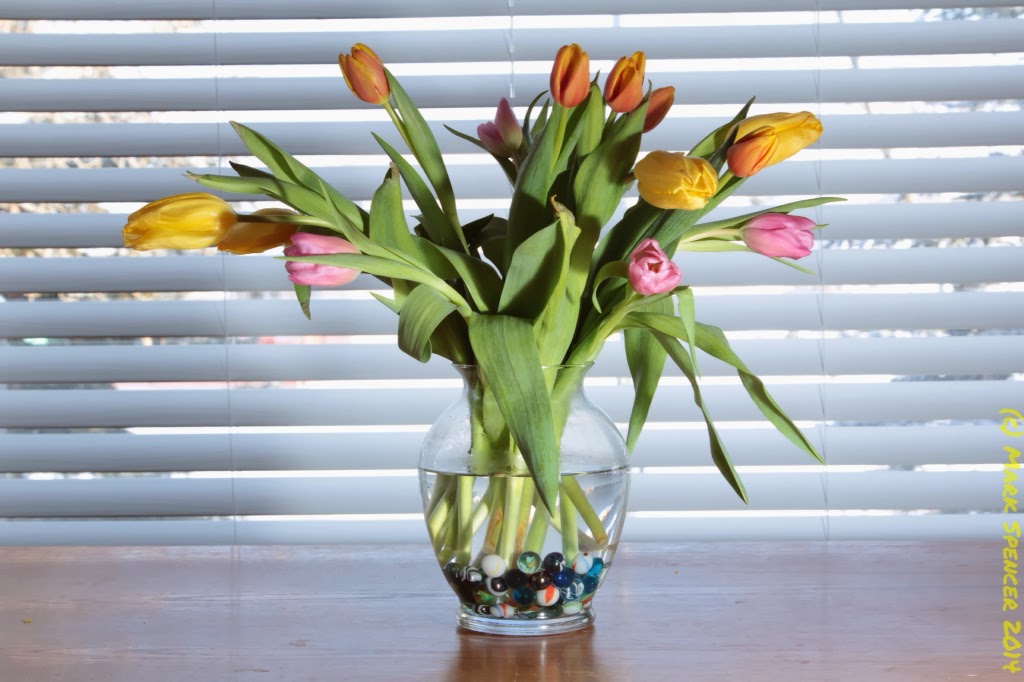
Pat really loves tulips. Since we are able to get cut tulips relatively I expensively, we have agreed that they make a nice addition to our table. And since it's too darn cold outside to shoot, it's time to practice some strobism. You know, using my flash to provide extra lighting ?

The Setup

The table has excellent lighting, owing to the bay windows. It's a bright sunny day out, and we often have to close the blinds partway to keep from getting overwhelmed by the sunlight ! I know, nice problem to have... So this shoot has the vase about two feet in front of the partially-closed blinds. From there, I set up my Canon 60D on a Manfrotto tripod, with the trusty 25-105mm f/4 L lens. I also used the Cacyus v5 transmitters to take the Canon 430EX flash off the body. I wanted to experiment with different lighting strengths & positions.

The Photos

I took about 25 photos. They have the flash in various positions, and in varying strengths. Like the camera, I operate my flash in fully manual mode as well.

This first image was the test-shot. I set my aperture, ISO & shutter speed to create a "perfect exposure. As you can see, the lighting from the window is beautifully exposed, but the flowers & vase are dark. We need a "fill" light.


The second image has too much flash ! Set at 1/8 power, the flash is overwhelming the shot, creating harsh shadows in the leaves.


In the third shot, I have dialled back the flash to 1/16th, which is better, but still a little strong for my tastes.


This fourth shot has the powers knocked back to 1/32 strength, but I also moved the placement of the flash. The colours are still nice & bright, without overwhelming the scene.


In this final shot, I moved the flash further away, dialled it back up to 1/16 power, and have it at almost 90 degrees (on the left side) of the flowers. I think the lighting is OK, but not nearly as dramatic as the fourth shot.


Lessons Learned

I have a lot to learn about studio shooting. And this was shot with only two light sources - the ambient light from the windows and a fill flash. In the future, I'd like to pick up another flash to do multi-plane lighting. I also kept the setup really simple - no reflectors or other mods. About the only mod used was a diffuser on my flash to soften the fill lighting, which I included after the second shot.